

Training
The Certificate of Advanced Studies develops skills to manage biobanks and strengthen quality and collaboration in clinical research
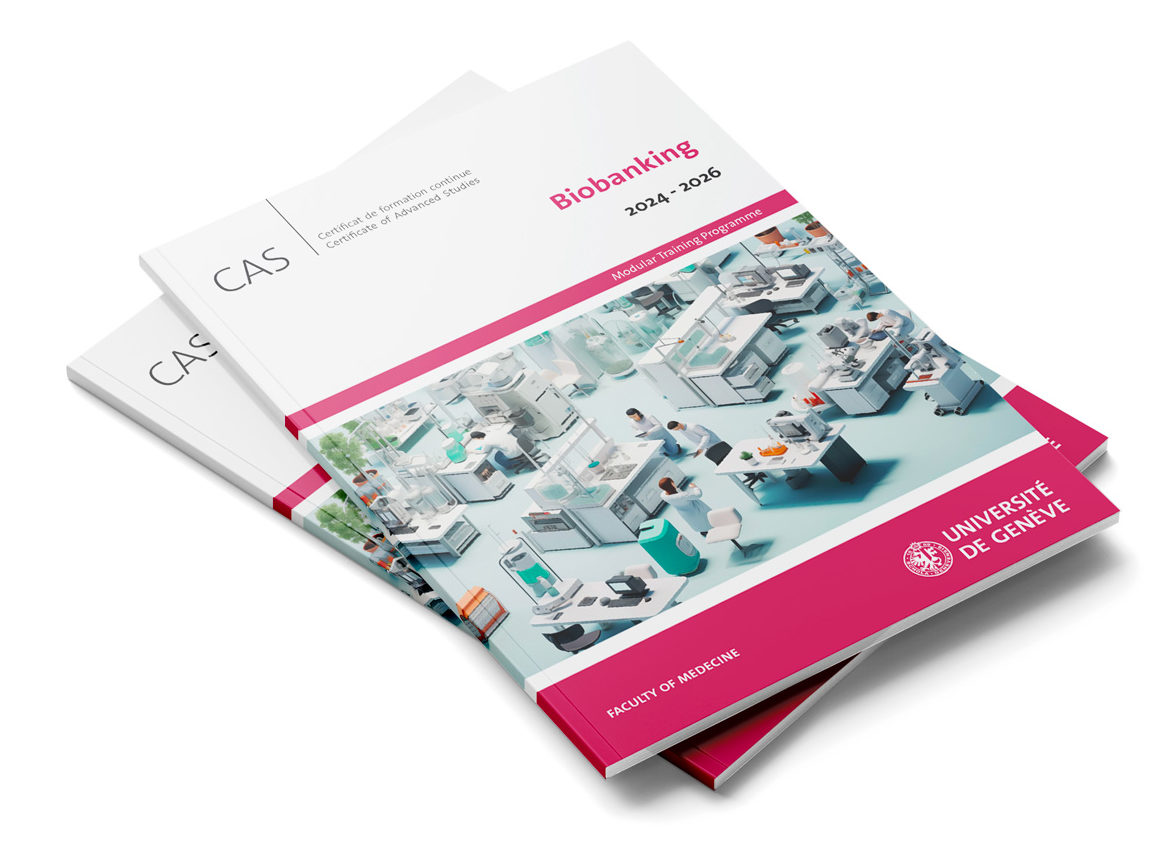
The Certificate of Advanced Studies (CAS) in Biobanking, developed in collaboration with the University of Geneva, the HSeT Foundation, and the Pasteur Institute, is an innovative training program designed for professionals worldwide with an interest in biobanking and research (e.g., PhDs, physicians, clinical investigators, ethics committees, and patient organizations). This state-of-the-art program aims to elevate quality standards, strengthen management protocols, and foster collaboration across clinical laboratory medicine and cutting-edge research.

Unique in Switzerland, the CAS is anchored within the Faculty of Medicine at the University of Geneva. The program is structured as a stepwise approach, allowing participants from beginners to highly specialized professionals to build knowledge progressively. Through its comprehensive modules, participants gain the practical skills needed for both the establishment and the day-to-day management of a biobank.
Key benefits
- Proficiency in state-of-the-art biobank management
- Gain essential knowledge and practical skills for establishing and managing a biobank
- Benefit from structured training modules covering operational, technical, and management aspects
- Harmonized practices to strengthen biobank operations
- Progress through a step-by-step program from foundational to advanced skills
- Apply practical tools, templates, and case studies to implement robust processes
- Alignment with international standards and networking
- Work in accordance with best practices in biobanking and research
- Connect with Swiss and international biobanking professionals and networks
- Earn a recognized certification (12 ECTS credits, University of Geneva)
- Flexible learning options
- Organize your training around your schedule with the e-learning format
- Complete all three modules for full certification, or start with Module 1 and receive a certificate of attendance
Who is it for?
- Professionals and researchers interested in biobanking and biomedical research, including:
- PhDs and postdocs
- Physicians and clinical investigators
- Members of ethics committees
- Patient organizations
- Anyone seeking specialized training to implement, operate, or manage state-of-the-art biobanks in Switzerland or internationally.
Modules
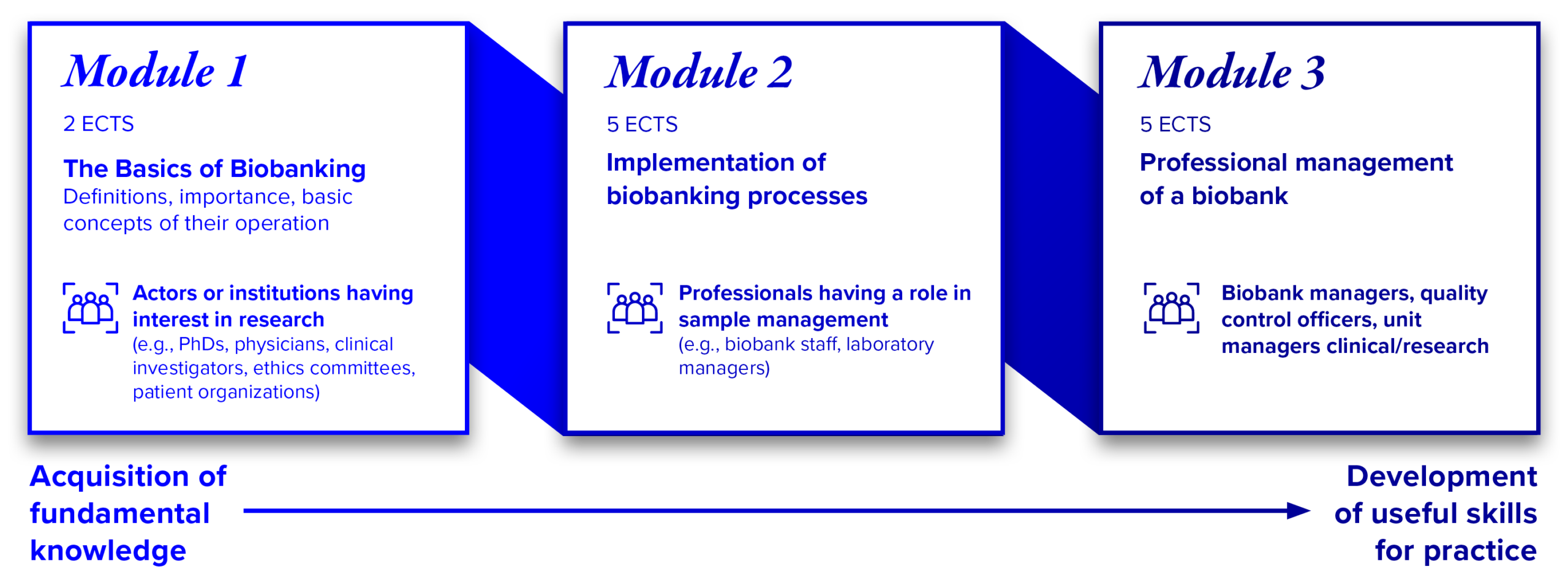
Module 1
The Basics of biobanking
- Recognize the importance of biobanks in improving research quality
- Understand the different types of biobanks and be aware of the main biobanking networks
- Master the ethical and legal framework relevant to biobanking
- Integrate the governance requirements for the implementation of a biobank
Module 2
Implementation of the biobanking processes
- Recognize and understand how to use the different types of consent
- Know and implement the required documentation to be set up
- Establish the technical and logistical aspects to ensure the exploitation of a biobank and guarantee the quality of the conserved resources
- Manage and maintain the resources necessary for a successful biobank operation
Module 3
Professional management of a biobank
- Recognize the processes and resources involved in the professional management of a biobank
- Understand and implement a QMS, measure its effectiveness and ensure continuous improvement
- Select the appropriate standards in adequacy with the defined quality objectives
Senior Consultant, wega Informatik AG
How to enroll?
- Candidates applying for the CAS or for one or more individual modules must hold a university bachelor’s or master’s degree, and in certain cases, provide proof of relevant professional experience
- Priority is given to participants who wish to complete the full program, although enrollment in one or two modules is also possible
- A new edition of the CAS begins every January
FAQ
Participants can generally expect a workload equivalent to 4 hours per week during Module 1, combining lectures, self‑study, assignments, and mandatory activities. The program is designed for professionals and aims to balance academic rigor with flexibility.
Module 1: 2 ECTS around 50-60h of study
Module 2: 5 ECTS 125-150h
Module 3: 5 ECTS 125-150h
A CAS typically requires 12 months to complete. Some participants may finish faster by taking consecutive modules, while others may spread their workload across a longer timeframe.
Yes. You may choose to register for Module 1 only as a stand‑alone continuing education unit, or later continue with the subsequent modules toward the full CAS. However, Module 1 is a mandatory prerequisite, so it is not possible to enroll in Module 2 or any later module without having completed Module 1. Completed modules can often be credited later if you decide to pursue the entire certificate.
- Full payment upon registration or
- Payment in installments (if requested)
Invoices are usually issued after registration confirmation.
Evaluation methods may include:
- Case Base Learning activities
- Article Base Learning activities
- Final exams after each Module
- Participation in discussions during interactive sessions (Module 2 and 3)
To obtain credit, participants must meet all evaluation criteria defined by each module.
Upon successful completion of all required modules, participants receive a Certificate of Advanced Studies (CAS) in Biobanking awarded by the hosting university or institution.
This certificate typically corresponds to 12 ECTS credits.
Contact expert
Valeria Di Cola
Education Officer
casbiobanking@unige.ch